Ask a room of screenwriters who buys their work and you will hear the same dozen live-action names. Almost nobody says "animation." Most picture a closed shop for people who can draw, a world where the writing happens somewhere they will never be invited.
The buyer data from the last two weeks says that picture is worth questioning. Animation was one of the most active buyer markets on the board, and the executives running it have been telling everyone, on the record, exactly what they want.
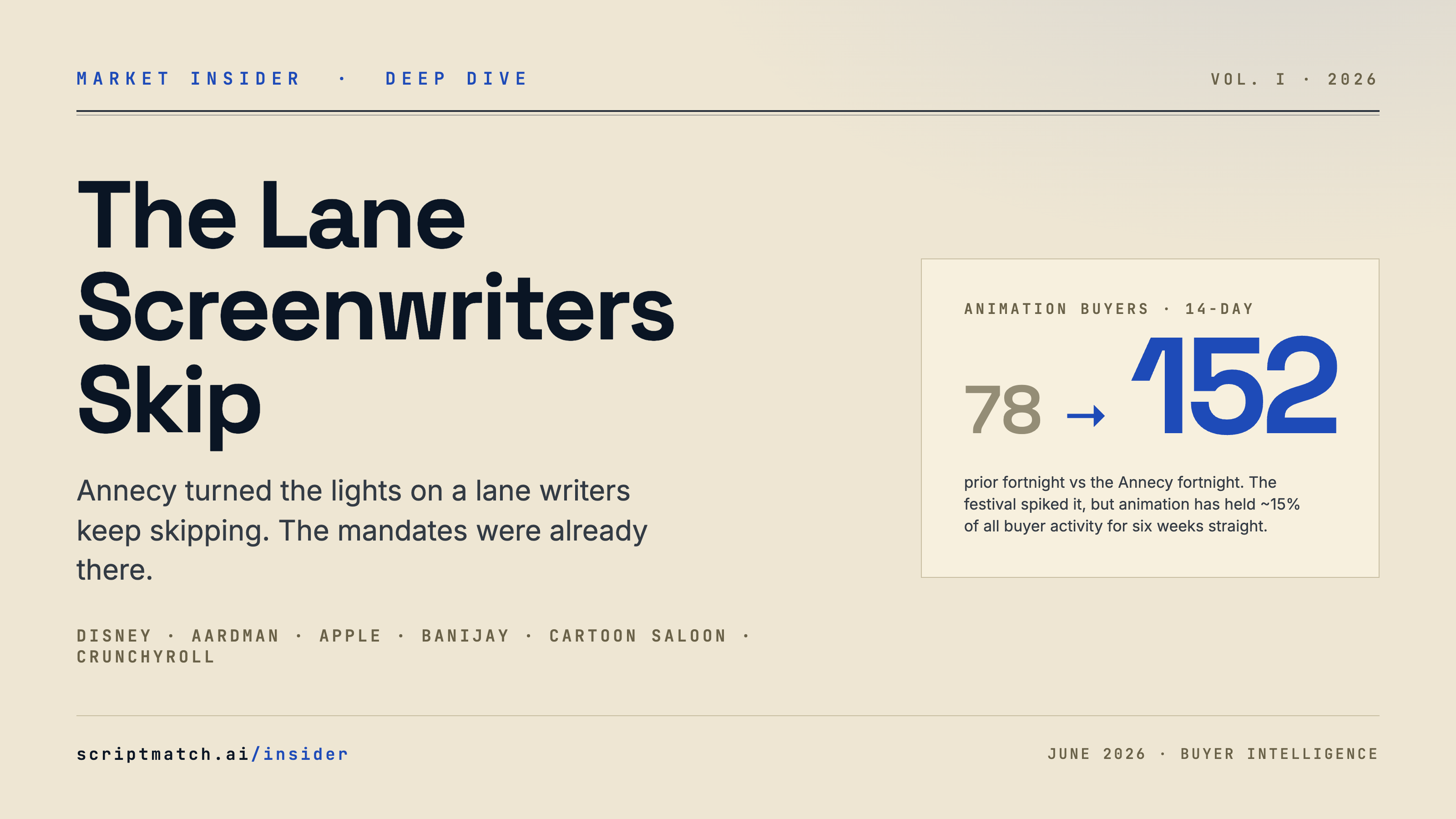
We track buyer activity across the trades every day, and in the last two weeks animation lit up. Some of that is timing. The Annecy festival and its MIFA market ran in mid-June, and a festival always spikes the headlines, the way Cannes does for live-action. But here is what Annecy did not invent: animation has held a steady 13 to 17 percent of all the buyer activity we track for six straight weeks, well before the festival. It was already one of the biggest lanes on the board. Annecy just turned the lights on and got the executives to say their mandates out loud. In the fortnight around it, 152 distinct companies signalled for animated, kids, and family content, from the majors to festival auteurs to a wall of international money. Here is who, by name, and what they actually asked for.
In this guide:
- The roll call: who is buying, by name
- The myth that keeps writers out
- What they actually want
- The honest version
- How to find the ones active on your project
- Common questions about selling to animation buyers
The roll call
Disney Kids & Family is adapting a book series most parents have never heard of and every nine-year-old has. At Annecy on June 18, Disney announced an animated "Warrior Cats" series for Disney+ and Disney Channel, built from Erin Hunter's novels (more than 90 million copies sold), with the rights held by Coolabi Group. President Ayo Davis put the mandate plainly: "We're always seeking out fresh, imaginative storytelling that resonates with families around the world." And note who got the keys to the adaptation: a writer, showrunner AC Bradley (Marvel's What If...?). Read that as book-to-screen, and someone has to write the screen part.
Aardman is pitching new originals, not just minding Wallace and Gromit. Chief Creative Director Sarah Cox spent the period announcing two fresh projects, "Let's Go Timmy!" and "Danger Delilah," and co-presenting a stop-motion Pokemon series reveal at Annecy. The Bristol studio that defines British stop-motion is in active development and openly talking about what it is pitching next.
Apple is buying prestige family animation with awards pedigree. Apple's animation calling card is "The Boy, the Mole, the Fox and the Horse," the Charlie Mackesy book it turned into an Oscar-winning short with director Peter Baynton. Its current animated slate runs to premium family projects, classic literary IP, and original songs, anchored by award-caliber teams, with its newest animated series coming from Cartoon Saloon. It is a "fewer but better" buyer, but every item on that list still starts with a script.
Banijay Kids & Family is chasing creator-led and adult animation. Chief Commercial Officer Delphine Dumont, acquiring the mockumentary series "Belzebubs" (born as a webcomic), called it "a standout title, unlike anything else in the market." In a separate move the same week, a production-tools partnership with Toon Boom, CEO Benoit Di Sabatino said the company is co-developing AI tools "to enhance rather than disrupt the creative process." That second move is the honest part of this story, and we will come back to it.
Cartoon Saloon wants folklore with a point of view. Co-founder and director Tomm Moore (Wolfwalkers, Song of the Sea) and CEO Anthony Leo described a mandate for hand-drawn 2D features rooted in picture books, folklore, and mythology, "culturally specific stories with universal emotional resonance around family, identity, and belonging." That is a writing brief, not a drawing one.
Charades is selling new voices off the festival circuit. The Paris sales house spent the fortnight moving director-driven animated features with Cannes and Annecy heat, including Kohei Kadowaki's debut "We Are Aliens," and leaning into international co-productions and coming-of-age stories. Its repeated phrase: "new voices in animation."
Crunchyroll is expanding anime across APAC. President Rahul Purini used an APOS keynote to announce Taiwan and South Korea expansion and a push into Korean webtoon-based IP for Gen Z and Gen Alpha. Webtoon adaptation is, again, an adaptation job.
That is majors (Disney, Apple, Paramount Animation, Warner Bros. Pictures Animation), specialty auteurs (Aardman, Cartoon Saloon, GKIDS), and global financiers (Banijay, Mediawan, Crunchyroll, Tencent, Toonz) all active inside two weeks. That is not a small or quiet corner of the market. The only thing that keeps a lot of screenwriters out of it is the assumption that it is not for them.
The myth that keeps writers out
Notice the word that never showed up in any of those mandates: draw.
What showed up instead was adapt. Disney adapting Warrior Cats. Apple adapting Charlie Mackesy and chasing literary IP. Cartoon Saloon mining folklore and picture books. Crunchyroll converting Korean webtoons. Banijay turning a webcomic into a series. Aardman extending and inventing characters. Every one of those is a story problem before it is an art problem, and animation studios are full of brilliant artists who are not screenwriters.
The barrier most writers picture, that you need to be an illustrator to get in, is not in the data. What these projects need is someone who can take a beloved book or a webcomic or a folk tale and find the movie inside it, and build a story that works for an adult and a ten-year-old in the same row. That is a writer's job.
What they actually want
If you want to aim at this market instead of admiring it, the last two weeks point a clear direction:
- Adaptation, heavily. Books, webcomics, folklore, picture books. If you can option-or-pitch an existing property and show the screen version, you are speaking their first language.
- Four-quadrant family, not just little-kid. "Family" here is the Pixar and Spider-Verse register: emotional, sharp, works for grown-ups too. Rare and valued.
- Original features still have a door. Warner Bros. Pictures Animation naming "original animated features" matters, because it means the whole lane is not locked to pre-existing IP.
- A specific voice travels. The festival end (Cartoon Saloon, Charades, GKIDS) rewards a point of view, the opposite of the anonymous work-for-hire grind people assume animation to be.
The honest version
We are not going to tell you this is wide-open spec territory, because the data carries the friction too. Some of this fortnight's volume is seasonal, since Annecy amplified the headlines, even though the underlying activity has run steady for weeks. A large share of these mandates are IP-driven, so an original pitch competes with a known title. A lot of the money is international co-production, which can mean a slower, relationship-led path. And the AI question is right there in Banijay's own words about building production tools, so go in clear-eyed about how some of this content gets made.
Treat it for what it is: a large, active market that rewards writers who can adapt, who can write four-quadrant, and who are willing to work in a medium they may have written off. It is not a lottery ticket. The demand is real, the buyers are named and on the record, and the main thing standing between a lot of writers and this work is the assumption that animation was never an option for them.
How to find the ones active on your kind of project
A market like this is easy to miss because the usual advice hands you a static list of "animation studios" that was accurate three years ago and tells you nothing about who is buying this month. That is the gap our free match tool is built to close. Put in your project and it returns the buyers most active on something like it right now, by genre and format, in under sixty seconds, with no signup. If your story has an animated, family, or adaptation angle, this is a good moment to run it, while the Annecy mandates are fresh.
It will not pitch the project for you. It hands you a researched, current shortlist and the intel to reach the right people, and you do the rest. But it is the difference between cold-emailing a studio that quietly closed its slate and walking up to a buyer whose president was quoted putting out a mandate at a festival last week.
The studios fighting over live-action drama will always be the headline. The buyer market that lit up around Annecy has been active for months, and if you have been writing animation off, it is worth a real second look. Run yours and see who is actually buying it.
Common questions about selling to animation buyers
Do animation studios buy or option scripts from outside writers? Yes, especially for adaptation and development. The 2026 mandates are full of book, webcomic, and folklore properties that need a screenwriter to turn into a series or feature. Disney's Warrior Cats adaptation handed the showrunner job to a writer, AC Bradley. The work is real, even though it rarely looks like a traditional open spec sale.
Do I need to be able to draw to write for animation? No. Animation studios are full of artists; what these projects need is someone who can build a story, structure an adaptation, and write a script that works for adults and kids at once. Drawing is a separate craft from writing the screenplay.
What are animation buyers looking for in 2026? Three things dominated the last two weeks: adaptation of existing IP (books, webcomics, picture books, folklore), four-quadrant family stories that play for grown-ups too, and a distinctive voice at the festival end. Original animated features still have a door, notably at Warner Bros. Pictures Animation.
Which companies are actively buying animation right now? In the trailing two weeks the active buyers included Disney Kids & Family, Apple, Aardman, Banijay Kids & Family, Cartoon Saloon, Crunchyroll, Paramount Animation, plus international financiers like Mediawan, Tencent, and Toonz. The list changes monthly, which is why the free match tool is more useful than a fixed directory.
Is AI replacing writers in animation? AI is entering the pipeline, openly. Banijay Kids & Family announced a partnership to co-develop AI production tools "to enhance rather than disrupt the creative process." But the work that buyers are paying for here is story and adaptation, which is exactly the part AI does worst and writers do best. Go in clear-eyed, not scared off.
How do I find animation buyers active on my specific project? Use a tool that tracks current activity rather than a static list. The free ScriptMatch match tool returns the buyers most active on a project like yours, by genre and format, in under a minute with no signup, including the ones that just added an animation or family mandate this month.