On July 1, Warner Bros. Pictures set a feature based on Siren Head, with Brian Duffield directing and Zach Cregger writing. Thirteen days later, Sony's TriStar Pictures took feature rights to Cartoon Cat.
Both characters were created by the same person: Trevor Henderson, a Canadian artist who posted monster photographs to Instagram. Cartoon Cat first appeared there in August 2018. Within two weeks this summer, his work was set up at two studios that compete directly with each other.
Henderson did not query Warner Bros. He did not query Sony. In both cases there was a group of producers sitting between him and the buyer, and they are the reason this happened at all.
That layer is the subject of this report. Not the deals, which the trades covered thoroughly. The structure underneath them, which they did not, and then the honest question of which part of it a writer without representation can actually use.
Every deal has more seats than you think
Start with the shape of a transaction, because it is where the opportunity hides.
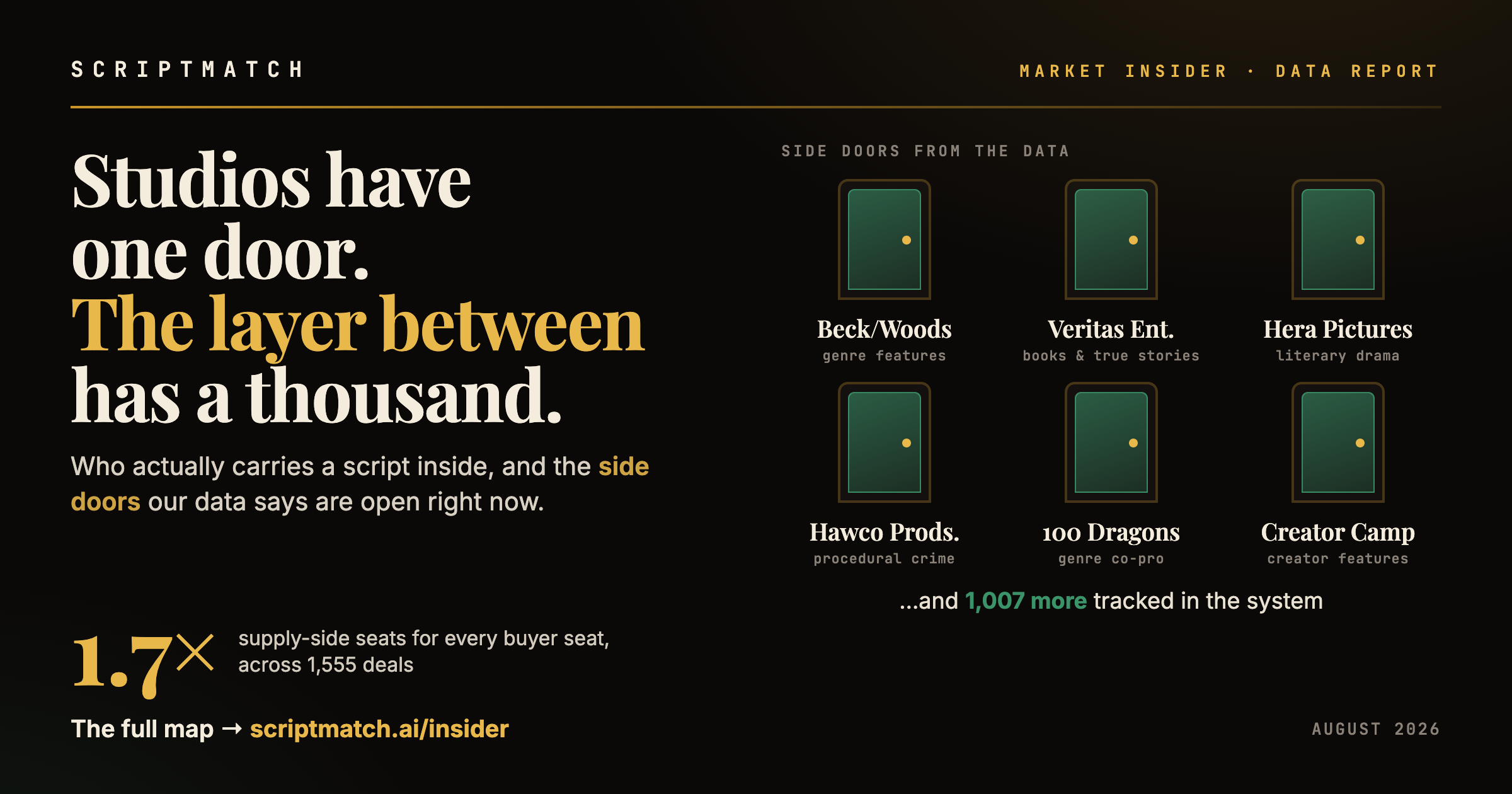
Across the last 90 days we logged 1,555 deals with more than one named party. The average deal has 3.38 parties. Of those, 1.03 sit on the buy side (the acquirer, commissioner or distributor) and 1.75 sit on the supply side (co-producers, production partners, financiers, sales agents).
That is roughly 1.7 supply-side seats for every buy-side seat. Most deals have exactly one buyer and two or three companies alongside it. And the two columns are made of completely different kinds of company: the buy side is roughly 93% studios, streamers and distributors, while the supply side is 70 to 77% independents and production companies.
The supply side is where most of the seats are, and it is full of companies that answer professional queries and build working relationships with writers. That is the part of the table worth getting to know.
The visible tip: eight people, four of them horror
Over the last twelve months we logged 96,713 named decision-maker mentions covering 36,467 distinct people. We asked how many appear in deals across five or more rival corporate families. Not five company names, which is easy when a conglomerate owns a dozen labels, but five genuinely competing owners. Warner Bros. and HBO count once. Warner Bros. and Sony count twice.
Eight people. Out of 36,467.
| Person | Rival families reached |
|---|---|
| Roy Lee | 7 (A24, Amazon, Lionsgate, NBCUniversal, Neon, Sony, WBD) |
| David Ellison | 6 (Amazon, NBCU, Netflix, Paramount, Sony, WBD) |
| Jason Blum | 6 (A24, Amazon, Lionsgate, NBCU, Paramount, WBD) |
| Neal H. Moritz | 6 (Amazon, Disney, Lionsgate, Netflix, Paramount, Sony) |
| James Wan | 6 (A24, Amazon, Lionsgate, NBCU, Paramount, WBD) |
| Steven Spielberg | 6 (Amazon, Apple, Disney, NBCU, Netflix, Paramount) |
| Steven Schneider | 5 (A24, Lionsgate, NBCU, Neon, Sony) |
| Seth Rogen | 5 (A24, Amazon, Apple, Disney, Paramount) |
Four of the eight are horror producers, in a genre that is under 3% of the genre mentions in our data. And the most connected person is not a studio chief: David Ellison runs Paramount and reaches six families, mostly through merger coverage. Roy Lee, a producer, reaches seven.
Watch how this played out with internet-origin horror, where the material came from outside the industry and had to be carried in by somebody:
| Property | Origin | Buy side | The layer in between |
|---|---|---|---|
| Backrooms | Kane Parsons, YouTube | A24 (co-financed with Chernin) | 21 Laps (Shawn Levy, Dan Cohen, Dan Levine), Atomic Monster (James Wan, Michael Clear), Oddfellows (Chris Ferguson) |
| Obsession | Curry Barker, YouTube | Focus Features | None. Bought straight out of the Toronto midnight section |
| Siren Head | Trevor Henderson, Instagram | Warner Bros. Pictures | Vertigo Entertainment, 12:01 Films, Jurassic Party Productions |
| The Mandela Catalogue | Alex Kister, YouTube | Amazon MGM, United Artists | Amblin (Spielberg, Holly Bario), Paper Street Pictures (Aaron B. Koontz) |
| Cartoon Cat | Trevor Henderson, Instagram | TriStar Pictures | Roy Lee, Steven Schneider, Scott Glassgold, J. Todd Harris |
| Curry Barker's next feature | Curry Barker | Universal, via Blumhouse Atomic Monster | Spooky Pictures, Divide/Conquer |
Vertigo is Roy Lee's company. Spooky Pictures is Steven Schneider's. The Cartoon Cat group contains both of them. The Backrooms roster contains three more of the eight.
Now the part most articles skip
You are never going to get Roy Lee on the phone. Neither are we. A producer with seven studio relationships is unreachable precisely because he has seven studio relationships, and anyone who tells you to cold-email Steven Spielberg is wasting your afternoon.
So the list above is not a call sheet. It is a demonstration that the layer exists and that it is where material actually moves. The useful question is what the rest of that layer looks like, because the eight names above are a rounding error inside it.
Here is the full size distribution of independent and production companies that took a co-producer or production-partner seat in the last 180 days:
Ten companies did six or more deals. One thousand and thirteen did one or two.
That is the actual shape of the bridge layer. It is not Roy Lee. Roy Lee is the 0.9% that trade coverage makes visible. The other 88% is a thousand small companies that each got one or two projects set up in six months, and whose names rarely make the trades.
Two more numbers before the examples, because they change how you should use any list, including ours.
First, a buyer is not one door. Netflix worked with 95 distinct supply-side partner companies in the last 180 days, 68 of them from the small tier. Amazon MGM and Prime Video worked with 79, and 90% of those were small. Warner Bros. and HBO Max: 54. Even Apple, the most closed shop in streaming, worked through 21 different partner companies.
When a writer says "this belongs at Netflix," that sentence names 95 different companies, most of them small, each of which got something to Netflix recently. The door is plural.
Second, the layer refreshes faster than any list can. Of the companies that took a supply-side seat in the last 90 days, 67% were appearing in our deal coverage for the first time in 14 months of continuous tracking. Two thirds of the layer, new inside one quarter. This is why static lists of production companies go stale the month they are published, and why the only durable method is watching the deals themselves.
What the reachable tier actually looks like
Real companies from the small tier, each taking a supply-side seat beside a named buyer in the last few months. We verified every row against the original trade coverage, and we grouped them by the lane they actually work:
If you write from books or true stories. Veritas Entertainment, a two-partner shop run by longtime industry veterans (Peter Jaysen and Alan Gasmer), just set The Naturalist at ABC, an adaptation of Andrew Mayne's bestselling thriller novels, with CSI veterans attached. Their model is finding optionable books and true stories and walking them to buyers. Hera Pictures did the same at Prime Video with What It Feels Like for a Girl and is, per the trades, actively acquiring novel rights. Neither is a household name, and neither is a beginner's door: these are professionals whose whole business is carrying material in. That is what makes the pathway worth studying.
If you write crime or regional drama. Newfoundland's Hawco Productions announced a development push in June with a hire whose stated brief is cost-effective productions that, in their words, over-deliver on budget, with procedural crime as the historic strength, feeding CBC. Denmark's Miso Film put a second season of The Uniform in business with Fremantle and the BBC on Nordic crime. Small offices, stated appetites, current deals.
If your material travels. Brazil's O2 Filmes is adapting Marcelo Rubens Paiva's memoir with Netflix Brazil and Amaia. Singapore's 100 Dragons found the kung fu comedy Kungfuland at an IP accelerator in Singapore and built it into a Canada-Singapore co-production. France's Miyu Productions is doing France-Japan animation co-productions positioned for festivals. The co-production market runs almost entirely on the bridge layer, and much of it is nowhere near Los Angeles.
If you came up online. Creator Camp, founded by three YouTubers, produced Two Sleepy People, a rom-com made for about $100,000 entirely outside the industry. It opened theatrically in 20 US markets in November, and France's mk2 alt then took European rights. Fox launched an entire division, Fox Creator Studios, and its first slate runs through small partner shops: CrossCheck, Bright Bay, YumCrunch. Pocket.watch just premiered Rabbit Hole on Disney+ and Hulu, packaging digital-native talent for streamers. This lane did not exist as a repeatable path three years ago.
If you write genre and want a new format. Charles Band's Full Moon is making Models vs. Werewolves for the vertical platform ReelShort, and the stated mandate is horror that can produce both a microdrama version and a feature cut. Vertical platforms are commissioning scripted genre at real volume now, and almost no screenwriters are watching that lane.
And the new banners. America Ferrera's Take Fountain, which hired a dedicated VP of development last year, just set a memoir adaptation at Warner Bros. with Heidi Schreck writing. Quinta Brunson's Fifth Chance moved to 20th Television on a fresh overall deal. Sydney Sweeney launched Honey Trap at Sony. A celebrity banner sounds unreachable, but a new banner with an overall deal is a small development office under pressure to build a slate, and its development staff, not the star, is who reads.
One more, as a reference point rather than a roadmap. Scott Beck and Bryan Woods, the writers of A Quiet Place, sold an original sci-fi spec this June, a script written on speculation with no buyer attached, to Amblin and Universal. Twenty years into their careers, with every door in town open to them, the sale still routed through a producer's seat. That is worth knowing for one reason: the structure is the same at every level. Yours starts smaller and closer to home, and the next section is about what that actually looks like.
What a yes looks like at this tier
Worth being concrete here, because nobody explains this part to a writer who has not been through it.
When a small production company likes your script, the outcome is usually not a purchase. It is an option or a shopping agreement: the company takes a time-limited, exclusive right to set your script up, sometimes for modest money, sometimes for none at all. That can feel anticlimactic. It is actually the mechanism working.
What you are getting is not the cheque. It is the company's relationships put to work on your material. They develop the draft with you, attach what they can reach, and walk it to the people you cannot: the sales agent they sold to last year, the regional fund that knows them, the buyer who took their call the last three times. Every pathway in the map below is one these companies have already walked, which is why a small shop with one deal to its name can do more for an unrepresented writer than a famous banner that will never open the attachment.
One working relationship at this tier is the difference between pitching Hollywood from the outside and having someone inside carry you. For a first or second script, that trade is almost always the right one.
How open is this layer, really?
Here is the sentence every screenwriter has memorized: "we do not accept unsolicited material." It is true where it comes from, and it comes from the buy side. It is a legal posture about receiving attachments, built to protect studios from idea-theft claims. What it is not is a statement that nobody in this business will hear a pitch.
The small tier behaves differently, and it says so in public. Inside our 180-day window:
- 105 of the 1,013 small companies stated their appetite in their own words in trade coverage.
- 62 explicitly said they are seeking partners or co-financing. The Czech Republic's D.N.A. Production put it in print in June: currently looking for streamers, broadcasters, distributors, sales agents and co-producers. That is not a company hiding behind a legal wall. That is a company advertising.
- 23 named writers, new voices or scripts as the thing they want.
- 151 surfaced at a festival, market, lab or co-production forum during the window, which is to say: rooms whose entire function is taking meetings, and which sell tickets.
And the institutional doors into those rooms are open applications, not connections. Frontières, the genre co-production market run by Fantasia with the Cannes Marché (and, new for 2026, tracks with the Berlinale's EFM, Tokyo and the TIFF market), takes project submissions from anyone for roughly a hundred Canadian dollars. Gotham Week's Project Market in New York, the oldest curated market in the country, is an open-application, meetings-driven forum that will host 80 projects this fall. Sunny Side of the Doc, where France's Yami 2 was publicly seeking pre-sales and co-producers in June, sells accreditation. These structures exist for exactly one reason: the layer sources from outside itself, on purpose, every year.
So the calibrated truth is this. A pitch is a conversation you request. An unsolicited script is an attachment you send. The first is normal business at this tier, done through queries, markets, labs and referrals. The second is what the famous sentence prohibits, and permission is what converts one into the other. The release form most small companies use is not a wall; it is the handshake that makes reading you legally safe. It exists because they do read outside material. What these companies are looking for is a working relationship. That is slower than a submission, and it is also why it holds once you have it.
The hop map: six ways into one company
Which brings us to the part this genre of article always skips: you have a target now, so how do you actually cross the last hundred feet? The answer is almost never the front door. It is a pathway: a hop through something adjacent to the target that is more open than the target, and that the target trusts.
The market hop. If the company attends markets, the market is the door. Accreditation at AFM, the EFM, MIPCOM or Sunny Side is purchasable, meetings are the product being sold, and the small tier attends precisely because it is hunting. Yami 2 did not stumble into Sunny Side; it went there to be pitched to and to pitch. 151 of our small tier surfaced at events like these in six months.
The lab and accelerator hop. Open applications that end with the layer reading you: Frontières for genre, Gotham Week for American indie and documentary, and the regional IP accelerators. This is not theory. 100 Dragons found Kungfuland at the ATF x SAAVA IP Accelerator in Singapore and built it into a Canada-Singapore co-production with named distributors attached. Someone's script was in that stack.
The festival hop. Programming is a certificate the layer trusts more than any query letter. Curry Barker's Obsession went from the Toronto midnight section to a reported $14 to 15 million Focus deal to a Universal deal with three bridge companies attached. The festival did the introducing.
The adjacency hop. When the target itself is unreachable, the nodes around it usually are not. Every deal row in our data names who the company works with: its co-producers, its buyer's other partners, the writers and directors it just hired, and its people. 453 of the small companies come with named individuals attached, a median of three each. The move is lateral: the development person at the target's co-producer, the writer one credit away who can say your name inside the building, the exec who just left and took the relationships along. You are not looking for the busiest person at the company. You are looking for the person whose job is finding things and whose inbox is not yet famous.
The regional hop. Hawco Productions is in Newfoundland. BiggerStage is in Limerick. D.N.A. is in Prague. Every one of them sits inside a public ecosystem of film commissions, regional funds and national screen agencies whose literal mandate includes connecting local writers to local producers. If you share a region, a language or a tax-credit jurisdiction with a company in your lane, that is not trivia. That is a door with a public servant holding it open.
The audience hop. The newest and most disruptive: bring your own evidence. Creator Camp turned a $100,000 rom-com made by YouTubers into a 20-market theatrical release and a European deal with mk2 alt. Toonstar says in print it wants internet-native creators. Pocket.watch packages digital talent for Disney+ and Hulu. For writers who also make things, audience numbers have become a currency the layer accepts at face value.
The method, then, is a pathway, not a scattershot. Pick the target from the layer: small, in your lane, active in the last 90 days. Find which doors that specific target actually exposes: does it attend markets, is it near you, who sits one node away. Then spend your effort on that pathway, not on the wall. The buyer sits behind the only wall on this map with no handle. Everything else here has a way through, and the people on the other side are the ones who build relationships with writers.
Fifteen side doors, straight from the data
The hop map is the method. Here is somewhere to practice it. Of the 1,013 small companies in the layer, 105 stated their appetite publicly, and these fifteen are drawn from that set: small or mid-sized on purpose, no marquee banners, each attached to a deal with a named buyer inside the last 90 days, and each verified against the original trade coverage before we printed the name.
- Beck/Woods (US, genre features), the A Quiet Place writers' own small banner, develops original genre scripts, exactly the kind they used to sell, and set one up in June.
- Veritas Entertainment (US, books and true stories) set The Naturalist at ABC. Two industry veterans whose whole model is optioning published material and walking it to networks.
- Hera Pictures (UK, literary drama) landed What It Feels Like for a Girl at Prime Video and is actively acquiring novel rights.
- Miso Film (Denmark, Nordic crime) renewed The Uniform with Fremantle and the BBC. Premium crime built for international licensing.
- Hawco Productions (Canada, procedural crime) feeds CBC and announced a development push in June, with cost-effective production as the stated brand.
- Kudos (UK, prestige drama) had House of Guinness renewed at Netflix in June. Strong narrative identity and award positioning are the house style.
- O2 Filmes (Brazil, co-productions) is adapting Marcelo Rubens Paiva's memoir with Netflix and publicly seeks international co-productions and co-financing.
- D.N.A. Production (Czech Republic, drama) put its shopping list in print in June: streamers, broadcasters, distributors, sales agents and co-producers.
- 100 Dragons (Singapore and Canada, genre) built Kungfuland into a two-country co-production out of an IP accelerator discovery.
- Miyu Productions (France, auteur animation) makes France-Japan co-productions aimed at festivals, with distributors already attached to We Are Aliens.
- Yami 2 (France, documentary) went to Sunny Side of the Doc in June publicly seeking pre-sales and co-producers on two projects.
- Creator Camp (US, creator features) turned a $100,000 rom-com into a 20-market theatrical run and a European deal with mk2 alt, and says it works with creators who have finished scripts.
- Pocket.watch (US, kids and family) premiered Rabbit Hole on Disney+ and Hulu in July, packaging digital-native talent for streamers.
- FMA, Full Moon Artists (US, vertical genre) is making Models vs. Werewolves for ReelShort and wants horror that can run as both a microdrama and a feature.
- Intelligent Animation (US, animation IP) says out loud that it wants IP holders who cannot afford traditional animation costs.
This list ages fast, and that is the point of everything above it: two thirds of the layer was new to our coverage inside one quarter, so treat these fifteen as a snapshot for aiming, not a directory. Match your lane before you move, pick the hop each one actually exposes, and check every company's current submission process on the day you use it.
The honest constraints
Calibration matters in both directions, so here is what has not changed.
Ask before you attach. The pitch-versus-unsolicited distinction only protects you if you honor it. A query or a meeting request is welcome at this tier; an unrequested PDF is still deleted unread, for legal reasons that have nothing to do with your writing.
Mass outreach still fails. The spectrum above is an argument for aiming at twenty right companies through the right hops, not for emailing a thousand.
A stated mandate is not a promise, and it expires. Two thirds of this layer turned over inside a quarter. Companies read hardest in the months right after they set something up, when the slate is thin and the pressure is fresh. Recency is most of the game.
Match the lane literally, or burn the contact. Sending elevated horror to a preschool animation shop does not just fail; it spends the one introduction you had.
And reps get sharper with targets. When a manager asks who you would take this to, naming five small companies with current matching mandates and a hop into each is a different conversation from naming Netflix. It is the conversation that gets a rep to actually work the script.
If you want to build the target list yourself: read the trade coverage of deals in your lane twice a week, skip the buyer in the headline, keep the companies in the second paragraph, and note where each one physically shows up. A month of that beats any static directory ever published, including anyone's database, because of that 67% turnover number.
Why the money is moving toward this
The appetite behind the internet-native wave was not created by producers. It was created by box office.
A24's Backrooms, directed by Kane Parsons at 20 years old, opened to $81 million domestic and $118 million worldwide and has since passed $375 million globally. That was the largest debut in A24's history, more than triple the $25.5 million record set by Civil War, and the biggest opening ever recorded for an original horror film. It crossed $100 million domestically in six days, the first A24 release to do so. Parsons became the youngest filmmaker ever to have a number one film.
By the time The Mandela Catalogue reached the market in July, it drew a reported eleven-studio bidding war. And at the opposite end of the budget scale, Two Sleepy People turned $100,000 and an online following into a 20-market theatrical release and a European distribution deal.
Note what happened to the creators. Parsons directed. Barker wrote and directed. Kister directs, from a script he co-wrote. Henderson took an executive producer credit on Siren Head. In every case the originator stayed attached rather than being bought out and replaced. That pattern is recent, and it is the most encouraging thing in this data.
What this does not mean
A company being small is not the same as a company being available, and a stated mandate is not an invitation. Submission policies change constantly, so check a company's current process before sending anything.
This is also not a claim that the bridge layer is new. Roy Lee has been doing this for two decades. What is new is how visible the routing became once material started arriving from outside the industry and needed carrying in, and how much of that carrying is being done by companies with one deal to their name.
One methodology note. Several publishers ask AI tools not to read their article bodies, and we honor that, so we read their headlines and syndicated summaries and source the same deal from outlets that permit it. That shifts which outlets our body-level reads come from, which can move a genre number without anything moving in the market. We control for that before publishing, and a few genre shifts we saw this month did not survive the check, so they are not in this report. The findings above come from company and people relationships across 90 and 180 day windows, which that change does not affect. And the map itself is a working document, not a finished one: it grows, corrects and re-verifies every week, because that is the only honest way to chart a layer that turns over this fast.
Related reading
The horror internet-IP supply chain report mapped the money chasing viral properties. The July buying-power ladder covered the mandates that opened in the same window. Our live Who's Buying Now board tracks activity between editions.
FAQ
What is a co-producer, and why does it matter to a writer?
A co-producer is a company that helps develop, package or finance a project alongside the company paying for it. They matter because they are the ones sourcing material. A buyer's job is to say yes or no to what arrives. A co-producer's job is to find things worth bringing, which is the only job description in this business that includes reading.
Can I actually pitch these companies?
Often, yes, if you understand the mechanics. A pitch is a conversation you request through a query, a market meeting, a lab or a referral, and at this tier that is normal business: 105 of these companies stated appetite publicly and 151 showed up at open events in six months. An unsolicited script is an attachment nobody asked for, and that is still deleted unread for legal reasons. Ask first; permission is what turns unsolicited into solicited.
Are the big names on the eight-person list reachable?
No, and we would not suggest trying. They are in this report to demonstrate that the routing layer exists and that it is where material moves. The thousand smaller companies underneath them are the part of the structure a working writer can realistically use.
What is an option, and is a small company optioning my script a good outcome?
An option is a time-limited, exclusive right to set your script up somewhere, usually renewable, sometimes for modest money at this tier. A shopping agreement is the lighter version: permission to take your script to specific buyers for a defined window. For a writer without representation, either one from an active small company is a genuinely good outcome, because what it buys you is their relationships: development, packaging, and someone whose calls get returned carrying your script into rooms you cannot enter alone. Have any agreement reviewed before you sign, and keep the window defined.
How were these companies identified?
We read trade coverage continuously and record every named party in a deal along with the role each played. Over the last 180 days that produced 1,145 independent and production companies holding a supply-side seat, of which 1,013 appeared in only one or two deals. Every company named in this report was verified against the original trade coverage before publication. Where a company stated its own appetite in its own words, we kept the language; we captured that for 105 of the smaller companies.
These are research starting points drawn from trade coverage, not offers or solicitations. Submission policies change; always verify a company's current process before sending material. ScriptMatch provides researched intelligence, not introductions.